

We love to blame the buzz. Let’s look at our own hand first.
Last time I ended with a line, “We reach for the phone too, and often no buzz comes first.” Here is where it comes from.
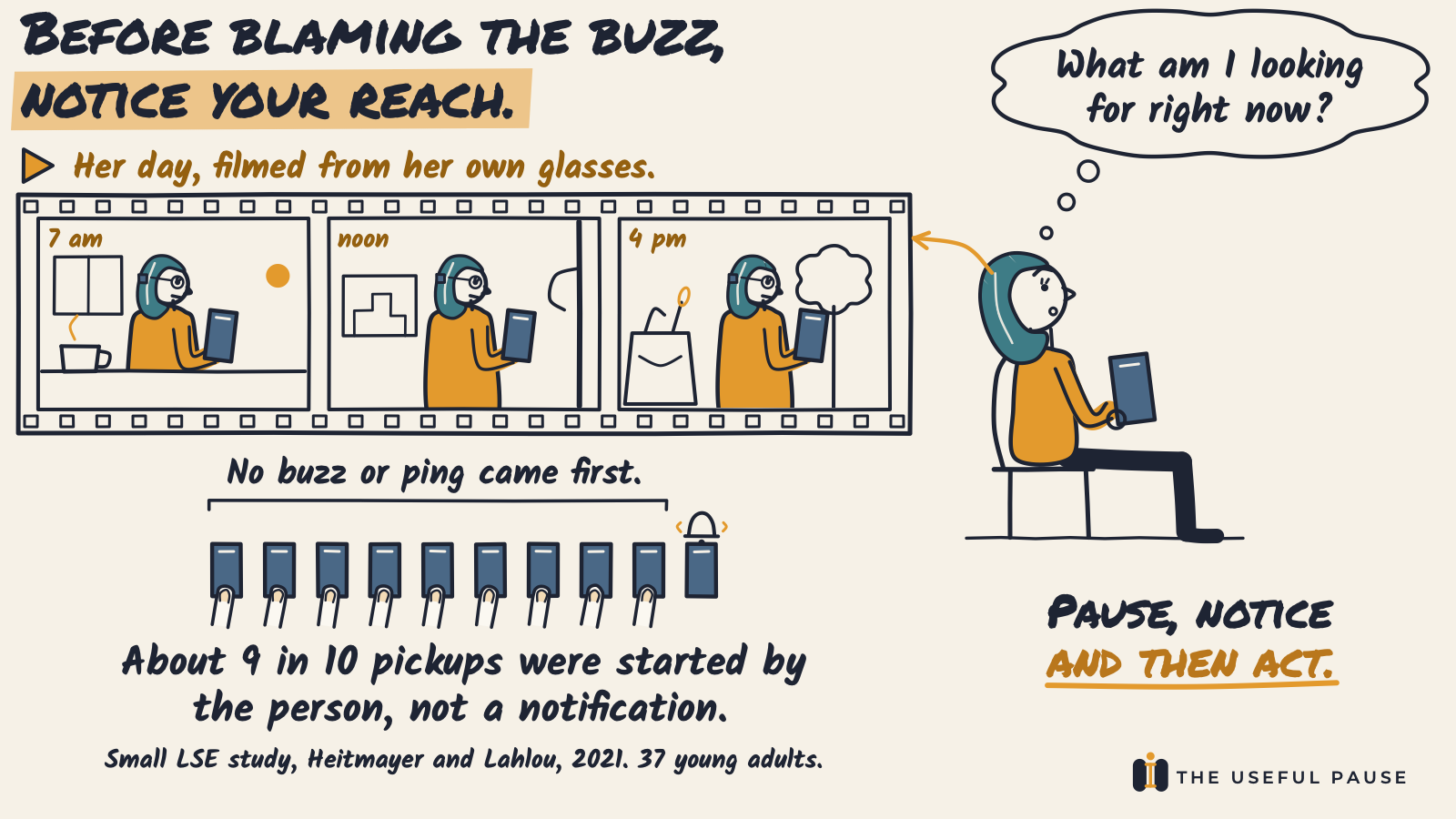
Thirty-seven young adults, aged 21 to 29, agreed to wear a tiny camera on their glasses for at least three days. Researchers Maxi Heitmayer and Saadi Lahlou, at the London School of Economics, then sat with each person and played their film back to them.
Most of them were surprised by how often their hand went to the phone, and how automatically.
Then the researchers counted. In this small sample, about 9 in 10 phone pickups were started by the person, not by a notification. No buzz or ping came first. On average, while the camera was on, they reached for the phone about every five minutes.
In You Are the Watcher, I wrote about watching a movie, so absorbed in the story that you forget you are still sitting in the theater. These 37 stepped out of the story of their day and watched it on the screen.
For me, this is not about blaming ourselves or saying we are addicted. Technology is not the enemy.
To be fair, buzzes matter too. In one lab test, people made more mistakes on a focus task when their phone got a call or a text, even though they did not pick it up. When I write, I turn my notifications off, except for a few people. That helps with the one in ten. For the other nine, there was no buzz to switch off.
If the reach begins with us, then the power to interrupt the habit begins with us too.
It isn’t only the phone. In the middle of a conversation, we don’t know something and we go straight to Google, or to the AI. Nothing asked us to. It is the same reach, and it breaks the flow of the conversation.
So here is the small version. Pause, notice and then act. The pause can be one second, before the hand finishes its move. In that second, we notice what is behind the reach. Is it actually necessary? Am I bored? What am I looking for right now? Am I avoiding something? Then we act. If we need the phone, we use it. If it was nothing, we put it down. Either way, we chose it.
I have been a big advocate of digital hygiene. We brush our teeth and take a shower every day, and nobody calls it a punishment. That’s how digital hygiene should be, simple daily care in how we use technology. A one-second pause before the reach is part of that care.
Noticing is not easy. Those 37 needed a camera to see how often they did it. It won’t change you overnight. But if you ask these questions each time, slowly you start to behave in a different way, and you may want to use the phone less. How much is up to you, and your body will tell you.
A word of care. This was a small group, young, mostly in London, and the filming is now several years old. It just shows a direction. It did not test whether pausing helps. That part is for each of us to try.
So should we quit? Giving up completely is another reaction. You become so focused on not picking up the phone that you stop watching yourself. The phone is one character in the film of your day, and a useful one. Use it fully, and stay in the seat where you can see the whole film.
Forwarded to you? Then ask our usual question. Was this useful? If it was, subscribe free, and the next one comes straight to you.
P.S. If you like what we do here and find it meaningful, would you invite one person to the discussion? Forward this post, or tap Share below.